


This is a chapter from my forthcoming book, The Urgency of Slowing. We read it aloud in the Porch Sit Revolution reading group this past Tuesday, passing it around the circle a paragraph or two at a time, and it is better now for the marks that room left on it.
There is a line further down about listening to witness a person rather than to fix them. That line is the whole of something Samir Selmanović and I made at Epic Ordinary. I call it An Hour to Be Seen. One hour. You talk, and I listen, the way most of us are almost never listened to. Then, within a couple of days, I send back the shape of what I heard, your own story told true on the page. The First Portrait of Your Epic Ordinary Life.
If something in these pages loosens a knot in you, consider that hour a door. You can walk through it here.
Now, the chapter.
In the innovation lab at the hospital, the walls were whiteboards and the thoughts were sticky notes, a hundred of them curling at the corners. A team of transplant specialists sat around the table. Most of them on call around the clock, their phones face-up beside the coffee, each phone a leash that could yank them out of the room and toward a stranger whose whole life had narrowed to a window of hours. They were in the business of saving lives. If anyone had earned the right to hurry, to skip the soft parts and get straight to the deliverable, it was these people.
They did the opposite.
We had gathered to work a knotted problem in their unit, and they carved out time—one could easily argue—they did not have. They showed up. They stayed in the conversation past the point of comfort. Sometimes frustrated. Often unsure. They let the silences sit in the middle of the table like an uninvited guest, and nobody rushed to fill them. What they made in the end worked. It was efficient enough. The thing I carry, though, is the way they left the room, a peaceful and connecting energy trailing off their shoulders like steam off a horse after a long climb, where something had been tended, and you could feel it on the skin of the air.
I had no name for it then. I have one now, or close to one.
They were practicing unhurried design.
Tania Anaissie, who founded Beytna Design, once told me that unless someone’s life is on the line, every deadline is made up. Here was a team with actual lives on the line, and even they understood that most of the urgency we manufacture is theater. A set built overnight. Lights, a clock, a manufactured sense of emergency, and behind the flat plywood, nothing.
The things most of us design synchronize to four values, and are the load-bearing beams of a McDonaldized world. Efficiency. Calculability. Predictability. Control1. I do not want to cast them as villains. They built the supply chain that puts fruit on your table in January. But when they become the only values in the room, the room goes a little dead, and we mistake the deadness for professionalism.
The strange bit about unhurried design is that it does not always look like design, not as we know it.
It might look like a slow walk through a field with a colleague, no agenda in your pocket. A meeting that opens with a long silence nobody apologizes for. A practice of listening to witness a person rather than to fix them, or even to answer them. Sometimes it looks like noticing what is already trying to happen in a room, and getting out of its way.
Conversation, held with care, can create something that does not yet exist inside any of the people having it. Rob Poynton put it to me more or less that way, and Johnnie Moore calls these unhurried conversations, the kind that feel inefficient while you are inside them and turn out, later, to be where the real alignment was quietly being made. Austin Kilroy once asked me what would change if the goal of a hard conversation were a better understanding of one another, and we let consensus arrive or not arrive on its own time. And Mark McCartney has spent years experimenting with silence in conversation, the deliberate invocation of it, and found that a small group of people sitting wordless together, in a room or across a screen, can fall into an intimacy that talk would only have interrupted.
Slowing asks for more courage than we admit. It is a way of leading by attunement to yourself and to the people in front of you, and a willingness to walk into the work without knowing what will come out the other side. That last part is the hard part. We have been trained to arrive with the answer already in our hands, to treat I don’t know as a wound to hide rather than a portal to somewhere new.
So what does an unhurried designer look like, moving through an ordinary day?
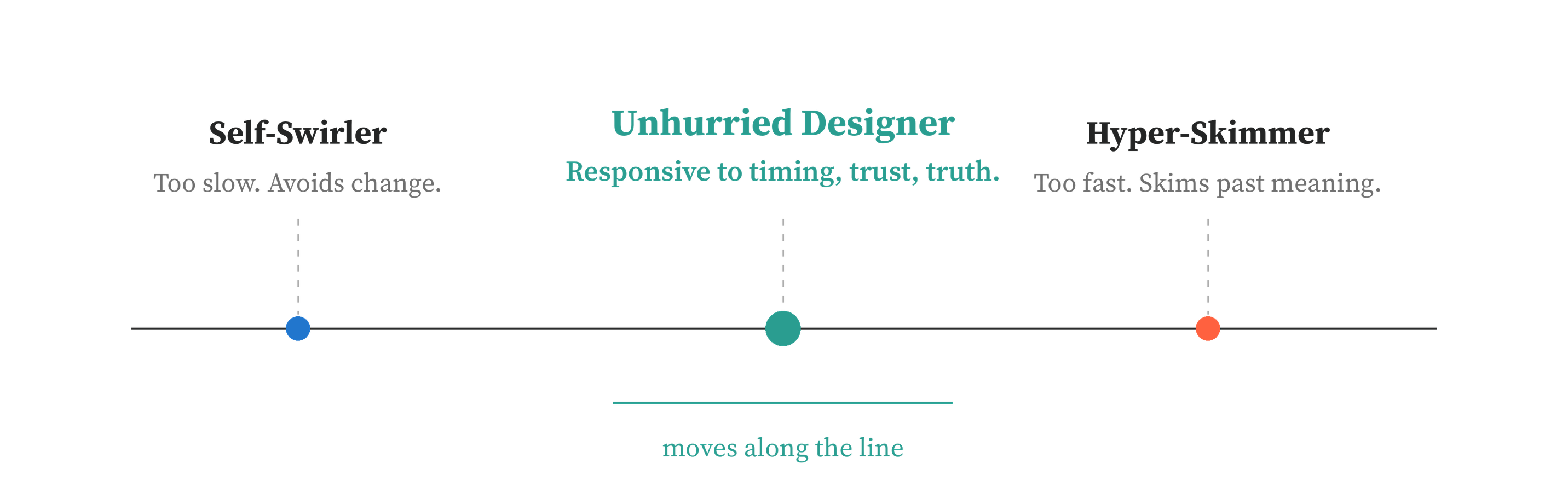
She recognizes when too much speed is a form of avoidance, the busyness we reach for so we do not have to feel the thing underneath it. And she recognizes, just as fast, when too much slow is its own avoidance, the endless circling that calls itself reflection and never has to risk a decision. Both are flights from the same discomfort. She is learning, instead, to find the right pace at the right time. The pace of relationship. The pace of trust.
Too fast, and we become hyper-skimmers, skating the surface of our own lives, skimming past meaning on the way to the next polished deliverable. Too slow, and we become self-swirlers, looping in our own depths, mistaking the loop for descent. The unhurried designer ranges the whole line between them. She reads each moment for the pace it asks and moves there, fast when fast serves the room, slow when slow does. Responsively. Relationally. With a skill that looks, from the outside, a little like grace.
I could hand you a list of practices here and am tempted to. Add ten percent more white space to your calendar and call it margin, the fertile ground where insight grows. Spend no more than a twenty percent of any meeting presenting and leave the rest for real conversation, the way Rob and Alex Carabi propose. Before you design for people, go on a field walk and learn with them. Take three or four ideas on a walk in the woods rather than wringing a hundred out of a whiteboard, and let your body loosen your mind’s grip. Wake without your phone and give the first half hour of the day back to yourself. Put the phone in a drawer for an afternoon, as a way of remembering that attention is finite and holy.
These are real. I have tried each of them. They have changed days for me, and changed more that is hard to put into words.
But to set them down as a numbered protocol, Seven Steps to Slower Design, would be to do what I am arguing against. It would McDonaldize slowing, take a living disposition and stamp it into a franchise you could roll out in any city and get the same flat result in every one. The practices are like doors. Nothing more, and nothing less. What matters is who walks through them, and the question they carry as they go.
Carry when will this pause end to a door, and the door stays shut. Carry I wonder how deep we can go, and it opens into somewhere you could not have planned.
Most of what we call design is the arrangement of dead materials. Wood, metal, pixels, plastic, the cold and obedient stuff that holds whatever shape we force on it and keeps it. Unhurried design is the tending of living things. A team. A conversation. A child. A forest. A story. A self. And living things keep their own time, like a wound that keeps its own time closing, like corn that keeps its own time growing in the dark.
You learn to move at the pace of what is alive. Rush it, and it withers in your hands.
I think again of that room in the hospital. The phones face-up on the table, gone quiet. People who had every reason to hurry, and didn't. What they carried out of there went past the solution they built. A connecting energy trailed off their shoulders, like steam off a horse after it had climbed for longer than it wanted. A strange sensation evoked. You could feel it on the skin of the air.
If you would like to join the Porch Sit Revolution, you can apply below. No expertise required. Let’s have an unhurried chat first.
All of my work is in service of ushering in a New Renaissance. Historically, renaissances have preceded social renewal and needed revolution. They are the inner work before the storm, the slow clearing that helps us see what we’re building toward and what we’re willing to march for. If you’d like to support this work, consider becoming a patron.
Unhurried Design is a life-centered approach to design created by Jordan Soliday and Johnnie Moore. We prioritize relationships and reflection, going the right pace at the right time, to yield resilient solutions with less material waste. This blog is organized into four sections:
Jordan is lost. Often slowing down and getting lost. Stories on the stubborn art of giving attention in a world skimming along the surface.
Johnnie is still walking. Often walking and talking. Reflections from decades of working unhurriedly with humans around the world.
Just the two of us. Conversations, collaborations, and the things we only find when neither of us is leading.
Porch Sit Revolution. A global practice of reading slowly, sitting together, and letting silence have the last word. Pull up a chair.
You can support our work by becoming a paid subscriber. Founding practitioners receive a complimentary session to unhurriedly design whatever matters most to them right now.
George Ritzer, The McDonaldization of Society (Thousand Oaks: Sage, 1993). Ritzer's four dimensions are efficiency, calculability, predictability, and control.